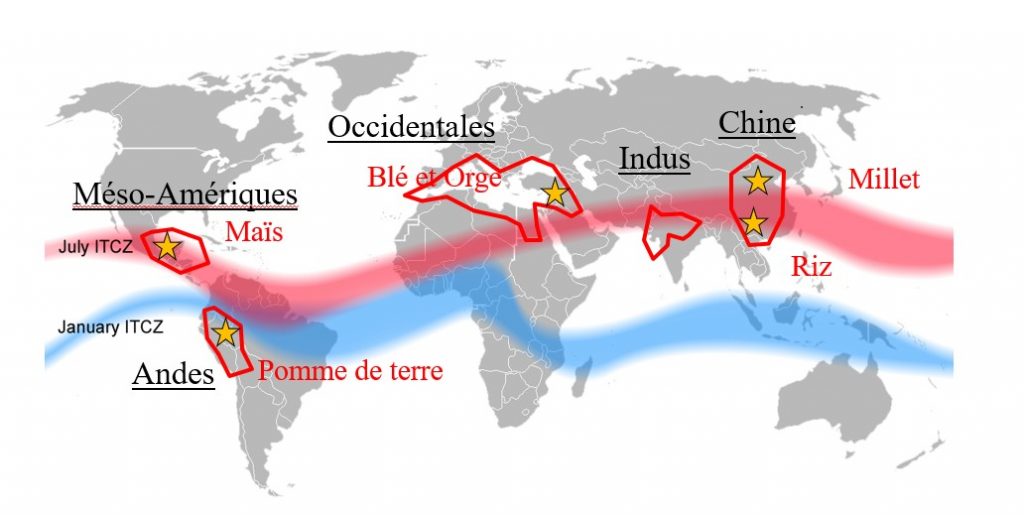
最近,较短时间尺度(达数十年)的ITCZ迁移已被研究证实,特别是在所谓的
早冰期(
Early Ice Age
)
[3]
。这时气候变化可以归因于许多因素,比如日照(sunstroke)的变化,一些大型火山的爆发,以及海洋和大气环流之间反馈机制的放大影响等等
[4]
。而这个位于自然证据(如湖泊或海洋沉积物,或洞穴石笋)证实了水平衡在这时发生了显著的变化,并且这些变化一定影响了人类赖以生存的农业资源。(那么,)又有哪些证据表明这些文明受到了
气候变化
的影响呢?
3. 苏美尔文明
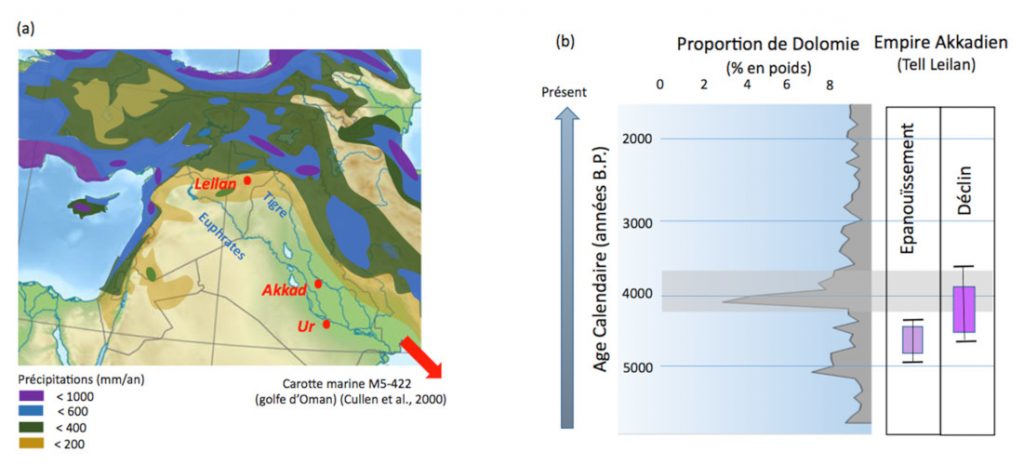
图2.(a)近东地区现代降雨分布以及一些古代城市的位置。 (b)左:阿曼湾M5-422海洋核心沉积物白云石含量的变化。这种矿物的存在证明该大陆处于干旱时期(灰阶图)。右:由雷兰城(Tell Leilan)(叙利亚)的发掘结果推导出的阿卡德帝国(Akkadian Empire)的年代。[左图改编自 Geyer and Sauvage, 背景地图: Виктор В CC BY-SA 2.0 (https://creativecommons.org/licenses/by-sa/2.0)] ;右图改编自 Cullen et al., 2000, 参考文献 5]
苏美尔文明在公元前2334年左右经历了一个转折点:新统领萨尔贡国王把各个城市聚集在新首都阿卡德麾下,建立了阿卡德帝国。然而,一个世纪后,也就是大约4100年前,这个帝国似乎遭遇了一次重大挫折。人们常用“阿卡德帝国的崩溃(collapse of the Akkadian empire)”一词来形容大城市在整个地区失去政治影响力,或是描述大型武力冲突和大量城市人口的流失。但通常来讲,4100年前后的这次崩溃并不是真正意义上的 “崩溃”,因为300年后该地区仍有阿卡德帝国统治的痕迹。
[1]
BOQUEHO V. Les civilisations à l’épreuve du climat, Dunod, “Quai des sciences”, 2012, 192 p.
[2]
Wanner H., Beer J., Bütikofer J., Crowley T.J., Cubasch U., Flückiger J., Goosse H., Grosjean M., Joos F., Kaplan J. O., Küttel M., Müller S. A., Prentice I. C., Solomina O., Stocker T. F., Tarasov P., Wagner M. and Widmann (2008), Mid-to Late Holocene climate change: an overview, Quaternary Science Reviews, 27(19-20), 1791-1828. doi:10.1016/j.quasi-cirev.2008.06.013.
[3]
Lechleitner F.A., Breitenbach S. F.M., Rehfeld K., Ridley H. R., Asmerom Y., Prufer K.M., Marwan N., Goswami B., Kennett D.J., Aquino V.V., Polyak V., Haug G.H, Eglinton T. and Baldini J. U.L. (2017) Tropical rainfall over the last two millennia: evidence for a low-latitude hydrologic seesaw, Nature Comm., doi:10.103B/srep45809.
[4]
Schurer A. P., Tett S.B.F., Hegerl G.C. (2014). Small influence of solar variability on climate over the past millennium. Nature Geosciences, 7: 104-108.doi:10.1038/ngeo2040.
[5]
Cullen H.M., deMenocal P.B., Hemming S., Hemming G., Brown F.H., Guilderson T. and Sirocko F. (2000), Geology, vol 28, n4, 379-382.
[6]
Weiss H., Courty M-A., Wetterstrom W., Guichard F., Senior L., Meadow R. and Curnow A. (1993), vol 261, pp 995-1004, doi: 10.1126/science.261.5124.995.
[7]
deMenocal P. B. (2001), Cultural responses to climate change during the Late Holocene, Science, 292, 667, doi: 10.116/science.1059827.
[8]
Railsback L. B., Liang F., Brook G. A., Voarintsoa N. R. G., Sletten H. R., Marais E., Hardt B., Cheng H. and Edwards R. L. (2018), The timing, two-pluse nature, and variable climatic expression of the 4.2 ka event : A review and new high resolution stalagmite data from Namibia, Quat. Sci. Rev., 186, 78-90.
[9]
Event recently ratified by the International Commission on Stratigraphy (ISQS, 2018).
[10]
Curtis J.H., Hodell D. A. and Brenner M. (1996), Climate variability on the Yucatan peninsula (Mexico) during the past 3500 years, and implications for Maya Cultural evolution, Quat. Res, 46, 37-47.
[11]
Martin S. and Gruβe N., Chronicle of the Maya kings and Queens, Thames and Hudson, 2005, 240p.
[12]
Curtis J.H., Hodell D. A. and Brenner M. (1996), Climate variability on the Yucatan peninsula (Mexico) during the past 3500 years, and implications for Maya Cultural evolution, Quat. Res, 46, 37-47.
[13]
Hodell D. A., Brenner M., Curtis J. H., Medina-Gonzalez, Ildefonso-Chan Can E., Albomaz-Pat A. and Guilderson T. (2005), Climate change on the Yucatan peninsula during the Little Ice Age, Quat Res., 63, 109-121. Doi:10.1016/J.yqres.2004.11.004.
[14]
Rosenmeier M. F., Hodell D. A., Brenner M. and Curtis J. H. (2002), A 4000 year lacustrine record of environmental change in the Southern Maya Lowlands, Peten, Guatemala, Quat. Res. 57, 183-190. doi:10.1006/qres.2001.2305.
[15]
Fleury S., B. Malaizé, J. Giraudeau, D. Galop, V. Bout-Roumazeilles, P. Martinez, K. Charlier, P. Carbonel and C. Arnauld (2014) “Impacts of Maya land use on Laguna Tuspan watershed (Peten, Guatemala) as seen through clay and ostracode analysis”. Jr Archaeo Sc., 49, 372-382.
[16]
Haug G.H., Günther D., Peterson L.C., Sigman D.M., Hughen K. A. and Aeschlimann B. (2003), Climate and the collapse of the Maya civilization, Science, vol. 299, 1731-1735.
[17]
Schurer A. P., Tett S.B.F., Hegerl G.C. (2014). Small influence of solar variability on climate over the past millennium. Nature Geosciences, 7: 104-108.doi:10.1038/ngeo2040.
[18]
Lechleitner F.A., Breitenbach S. F.M., Rehfeld K., Ridley H. R., Asmerom Y., Prufer K.M., Marwan N., Goswami B., Kennett D.J., Aquino V.V., Polyak V., Haug G.H, Eglinton T. and Baldini J. U.L. (2017) Tropical rainfall over the last two millennia: evidence for a low-latitude hydrologic seesaw, Nature Comm., doi:10.103B/srep45809.
[19]
Arneborg J., Heinemeier J., Lynnerup N., Nielsen H., Rud N. and Sveinbjörnsdottir A.E., (1999), Change in the diet of the Greenland vikings determined from stable carbon isotope analysis and 14C dating of their bones, Radiocarbon, Vol 41, 157-168.
[20]
Zhang P., Cheng H., Edwards R. L., Chen F., Wang Y., Yang X., Liu M., Tan M., Wang X., Liu J., An C., Dai Z., Zhou J., Zhang D., Jia J., Jin L. and Johnson K. R., (2008), A test of climate, sun and culture relationship from an 1810-year Chinese cave record, Science, vol 322, 940-942, doi: 10.1126/science.1163965
[21]
Day M.B., Hodell D. A., Brenner M., Chapman H.J., Curtis J. H., Kenney W. F., Kolata A. L. and Peterson L., (2011), Paleoenvironmental history of the West Baray, Angkor, Cambodia, PNAS, vol 109, 1046-1051, doi: 10.1073/pnas.1111282109.
[22]
Schaefer J.M., Denton G. H., Kaplan M., Putnam A., Finkel R.C., Barrell D. J. A., Andersen B. G., Schwartz R., Mackintosh A., Chinn T and Schlüchter C., (2009), Hign frequency Holocene Glacier fluctuations in New Zealand differ from the Northern Signature, Science, vol 324, 622-625, doi:10/1126/science.1169312.
[23]
Orliac M. (1986), A la recherche des anciens polynésiens, Tahiti et Moorea, in’Encyclopedie de la Polynésie, Vol 4, p82-83, ed C. Glizal/ les éditions de l’Alizé.
[24]
Nelson D. B. and Sachs J. P. (2016), Galapagos hydroclimate of the common Era from paired microalgal and mangrove biomarker 2H/1H values, PNAS, vol 113 3476-3481, doi: 10.1073/pnas.1516271113.
MALAIZE Bruno
, 马拉泽 布鲁诺,高级讲师,HDR, UMR 5805 EPOC (Environnements et Paléoenvironnements Océaniques et Continentaux, 海洋大陆环境与古环境实验室) ,Université de Bordeaux (波尔多大学)